
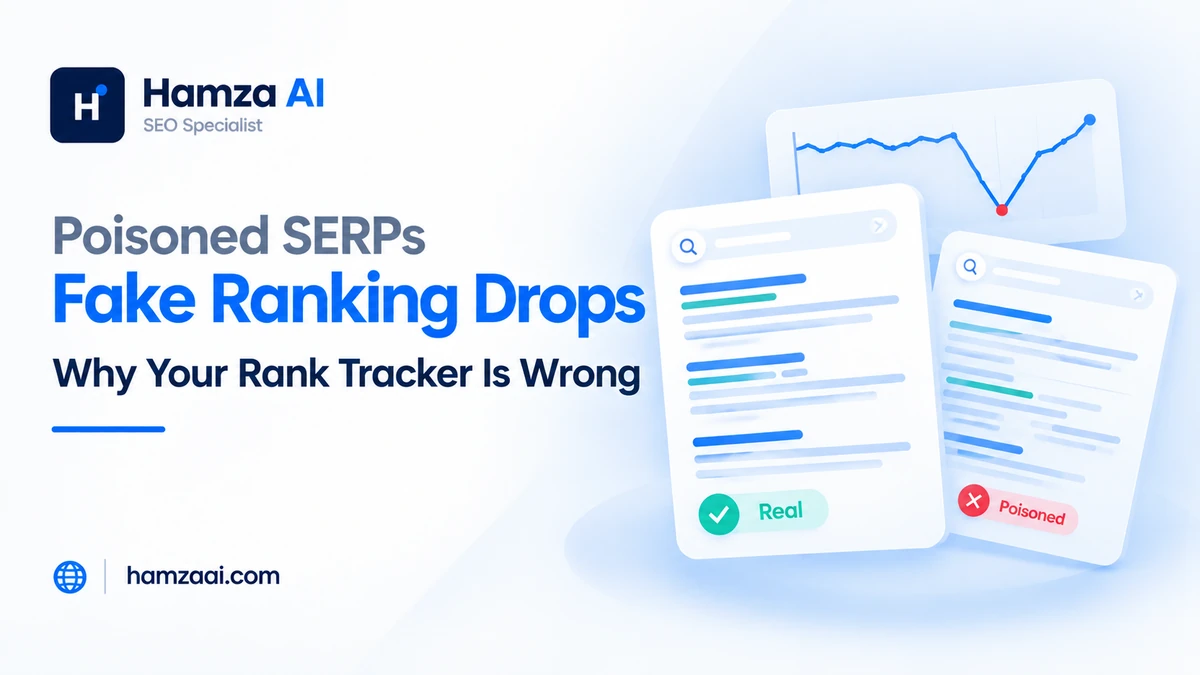
Since late September you may have seen your best keywords disappear from your rank tracker overnight and then come back the next day. You weren’t imagining it, and your website probably wasn’t penalised. The SEO industry now has a name for this: poisoned SERPs.
When a client’s report shows a sudden drop, the first question I now have to ask is whether the drop is real or whether Google sent the tracking tool a fake page. This article covers what is verified so far, how we got here, and how you can check your own data. Every figure is linked to its source. My own opinions are kept to one clearly labelled section near the end.
Key takeaways
- Google is serving some rank-tracking tools complete, normal-looking results pages with the organic listings swapped out.
- The scale depends heavily on the tool. One study found 8% of pages affected, while another tracker reported about 1% after filtering.
- Most poisoned results last one day. A drop that reverses the next day is most likely bad data, not a penalty.
- Google Search Console is the most reliable check, because it records real searches rather than scraped pages.
- As of 19 October 2026, Google had made no public statement about the issue.
What is a poisoned SERP?
A SERP is a search engine results page. Rank trackers such as AccuRanker, Semrush and Ahrefs check your keywords on Google automatically, many times a day, and record where your site appears.
A poisoned SERP is a page Google sends to one of those automated checks that looks normal but lists different websites. The familiar layout, ads and AI Overviews are still there; only the organic listings change. Because nothing on the page looks wrong, the tracker stores it as a real ranking, and your report shows a drop that never happened for real searchers.
This is worse than a simple block. When a request is refused, the scraper knows to try again. A poisoned page gets saved as if it were real.
How we got here: Google vs rank trackers, 2025 to 2026
Poisoned SERPs are the latest step in a long effort by Google to limit automated scraping of its results.
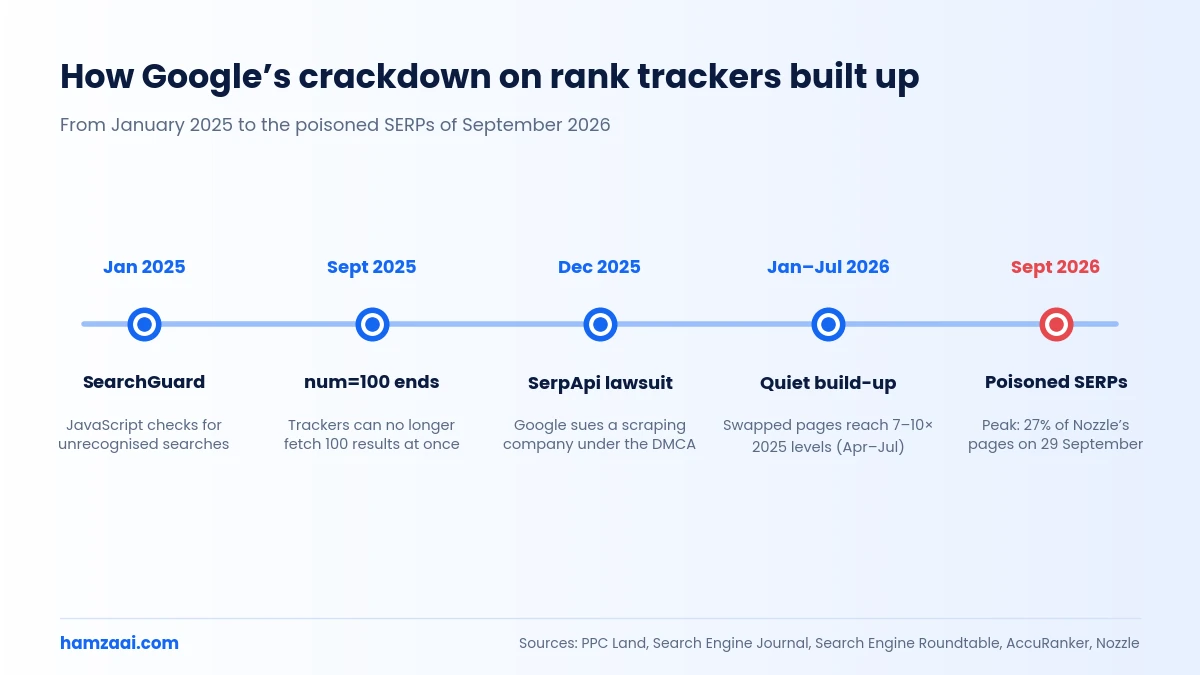
January 2025: SearchGuard. Google launched a protection system it calls SearchGuard, which sends JavaScript challenges to searches from unrecognised sources so that browsers have to prove the request comes from a person rather than a bot.
September 2025: the end of num=100. Around 10 to 14 September 2025, Google stopped supporting the num=100 parameter, which many rank trackers used to fetch 100 results in a single request (Search Engine Roundtable). When asked, Google said it was not an officially supported feature. Many site owners saw desktop impressions fall in Search Console at the same time, because bot-generated impressions disappeared from the reports.
December 2025: legal action. On 19 December 2025 Google filed a federal lawsuit against SerpApi, a Texas company, alleging it circumvented SearchGuard to scrape Google results. The case was brought under the US Digital Millennium Copyright Act (Search Engine Journal coverage).
January to July 2026: the quiet build-up. AccuRanker checked its stored data afterwards and found the pattern had started well before September. From late January 2026 it saw smaller rounds of swapped pages, often hitting local searches first, and from April to July they ran at roughly 7 to 10 times their 2025 level.
September 2026: the big jump. Blocking intensified from 13 September, and poisoned pages appeared from 20 September in Nozzle’s data and 24 September in AccuRanker’s. The timing overlapped with Google’s September 2026 spam update, which ran from 24 September to 8 October according to the Google Search Status Dashboard. That overlap matters because some sites had real ranking changes in the same weeks their trackers were showing fake ones.
What the data shows right now
Nozzle’s study: 27.5 million results pages
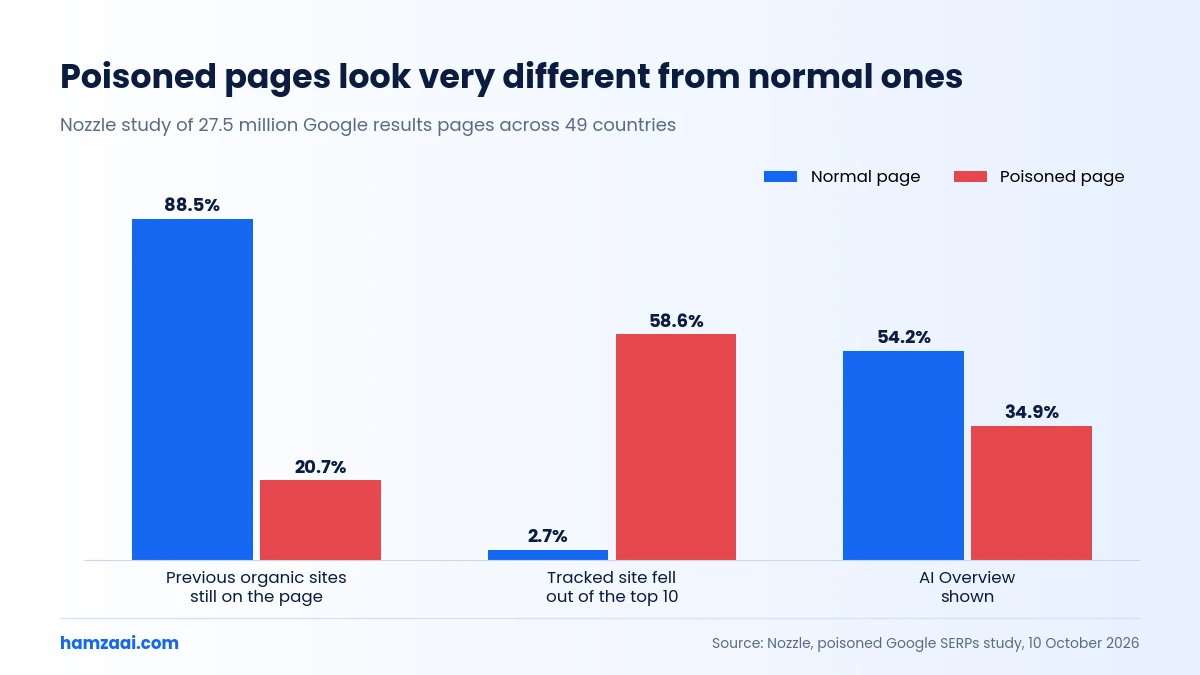
The first large study came from rank-tracking company Nozzle. Its 10 October 2026 study of 27.5 million Google results pages across 49 countries found 8.0% poisoned since 13 September, compared with 0.17% before. The share peaked at 27.0% of collected pages on 29 September and ran at about 5 to 11% a day from 1 to 9 October, the last day of Nozzle’s published data.
The swapped pages looked very different from normal ones:
- Poisoned pages kept only 20.7% of the previous page’s organic sites, compared with 88.5% normally.
- When a page was poisoned, a tracked site fell out of the top 10 58.6% of the time, against 2.7% in normal conditions.
- AI Overviews appeared on 34.9% of poisoned pages, compared with 54.2% before.
AccuRanker’s numbers: a spike, then about 1%
AccuRanker published its own data on 19 October. On the first day, more than a quarter of its monitored keywords came back with a swapped first page. Within two days it had brought that below 2%, and stricter checks in mid-October brought it under 1%.
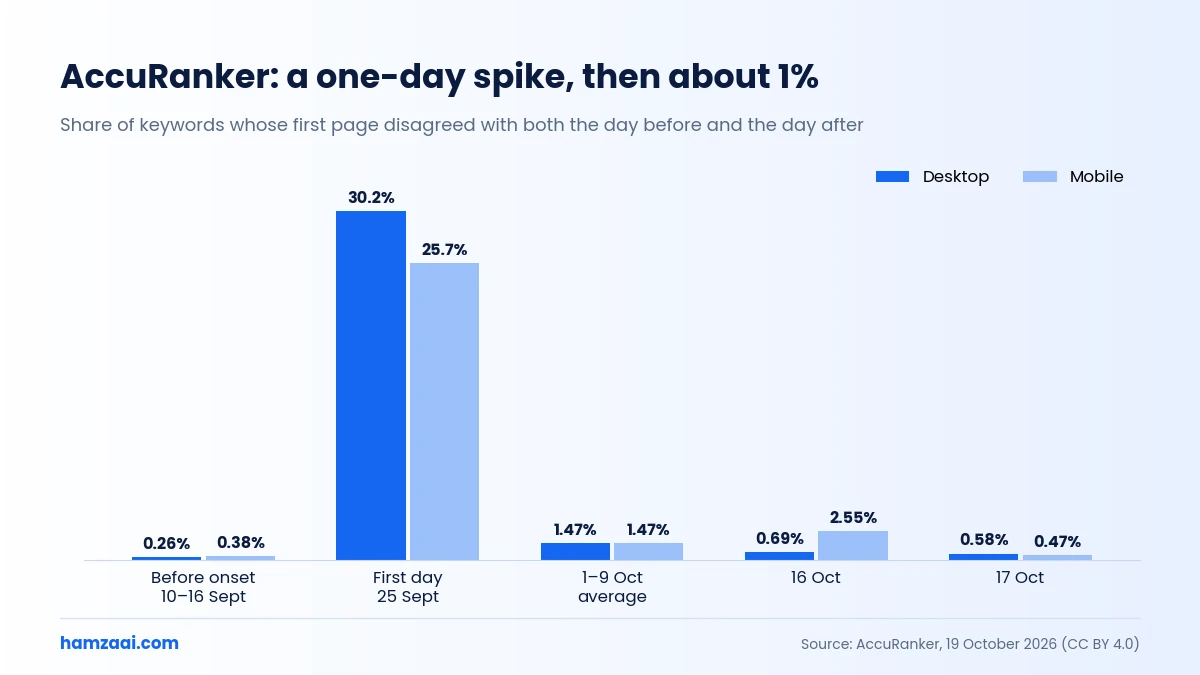
| Period | Desktop | Mobile |
|---|---|---|
| Before the onset (10–16 September) | 0.26% | 0.38% |
| First day (25 September) | 30.2% | 25.7% |
| 1–9 October | 1.47% | 1.47% |
| 16 October (after Google’s next change) | 0.69% | 2.55% |
| 17 October | 0.58% | 0.47% |
Two of AccuRanker’s findings matter most for anyone reading a ranking report:
- Most poisoned results last a single day. More than 9 in 10 runs of poisoned days lasted one day, and only about 2 in 100 lasted three days or longer. When AccuRanker fetched an affected page again in a new session, it came back normal about 3 times in 4.
- It depends on how the data is collected, not on what you track. Google appears to decide per browser session rather than per keyword, so two searches for the same keyword at the same moment can get different pages.
The issue is also still changing. Google tightened its detection again on 15 October, mostly on mobile, and by 17 October AccuRanker had both devices under 1% again.
Why the numbers disagree so much
Eight percent and one percent sound like a contradiction. They aren’t, because the two companies measured different things. AccuRanker filters suspicious pages and fetches them again before storing anything, so its figures describe what reached customer dashboards. When AccuRanker applied Nozzle’s rule to its own data, it averaged 1.5% a day for 1 to 9 October, about a fifth of Nozzle’s rate. On 29 September, when Nozzle peaked at 27%, AccuRanker’s rate was 1.4%.
The practical lesson: how reliable your ranking data is now depends on how your particular tool collects and checks its pages.
What other tools are saying
- Semrush confirmed the issue. It told Search Engine Roundtable it has been seeing Google return inaccurate results since late summer, and that remaining cases mostly appear beyond the first page of results.
- SE Ranking said the issue still affected roughly 2% of tracked results and that the share was shrinking (Search Engine Watch).
- BrightLocal, a local SEO platform, reported that regular desktop and mobile results were significantly affected, the Map Pack and Local Finder less so, and Google Maps results not at all (BrightLocal update).
Has Google said anything? As of AccuRanker’s 19 October post, Google had made no statement, including about how long this will last. The idea that it is part of Google’s fight against AI scrapers is a theory from the tool vendors, not something Google has confirmed.
What this means for Australian local businesses
If you run a local business in Australia, three points apply to you directly.
1. Australian data may have been hit hard on the worst days, but the evidence is mixed. An independent analysis of Nozzle’s public data found that on 29 September about half of Canadian and Australian results pages were poisoned, against under 3% of UK pages. AccuRanker’s filtered data shows the opposite picture: across 22 markets every country fell between 1.1% and 1.7%, and New Zealand had its lowest rate. AccuRanker reads this as more evidence that the collection method, not your country, decides how much bad data you see.
2. Local results can show businesses from the wrong city. A poisoned local search can list businesses from other cities while the location line at the bottom of the page still names your city. If your Brisbane plumbing report suddenly shows Sydney competitors, treat it as a warning sign.
3. Your Google Business Profile data is more reliable. Based on BrightLocal’s reporting above, Google Maps results were not affected and Map Pack tracking was affected less. For most tradies and local services, calls, direction requests and website clicks from your Google Business Profile are a far better measure of performance than one day of organic rank data.
How to tell a fake drop from a real one
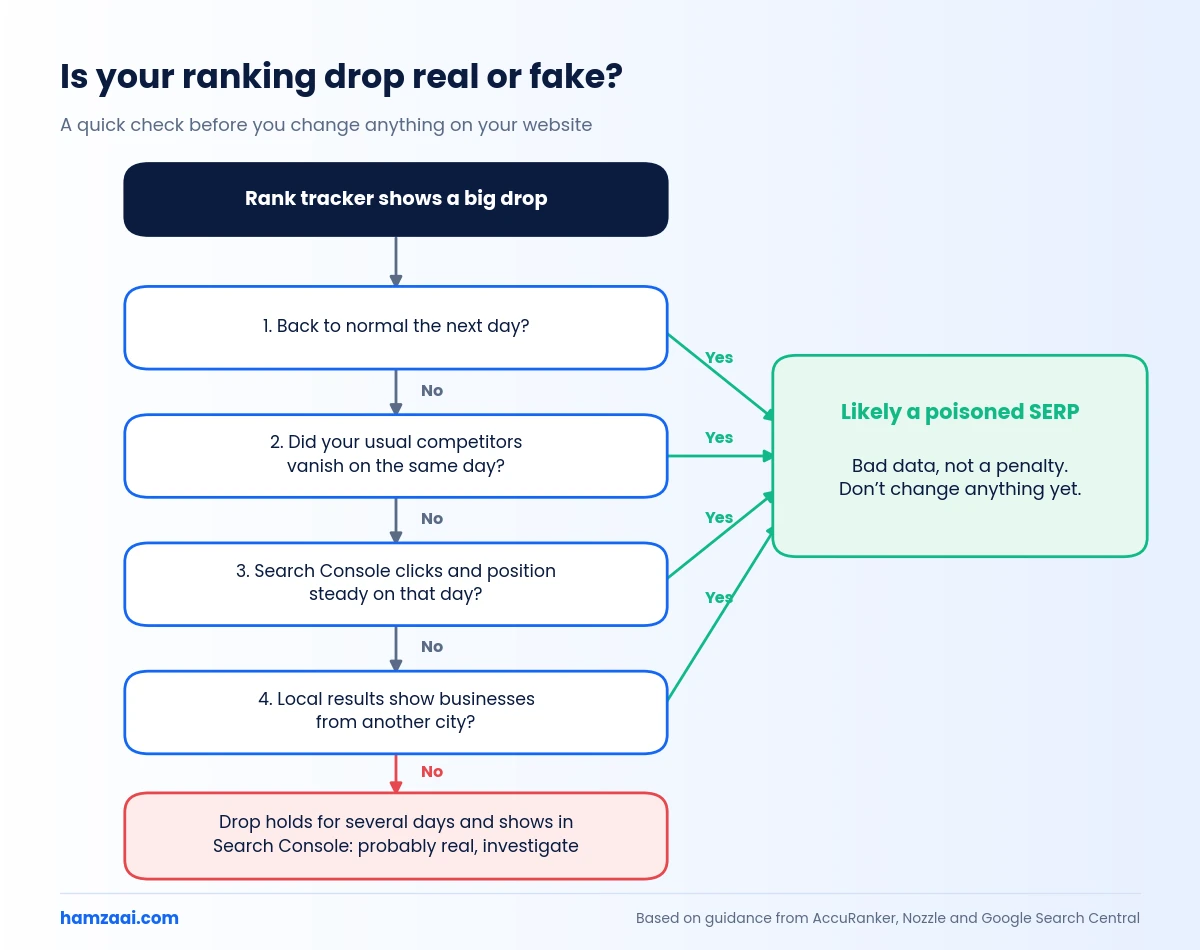
Before you rewrite pages, change your SEO provider or panic about a penalty, run through these checks. They are based on the guidance published by AccuRanker and Nozzle, plus Google’s own guide to debugging traffic drops.
- Wait a day. A one-day drop out of the top 100 that is back the next day is most likely bad data, not a penalty.
- Look at your competitors on the same page. If most of your usual competitors vanished on the same day as you did, suspect the data rather than your website.
- Open Google Search Console. Filter the Performance report by the same keyword and date. If your average position and clicks held steady that day, the drop in your rank tracker was most likely a poisoned page. Keep in mind that the most recent data is provisional: the 24 hours view shows figures within a few hours, but they can change before they are finalised, so compare a full day once it has settled.
- Check for wrong-city results in local searches, as described above.
- Ask your rank tracker how it handles this. AccuRanker suggests asking whether your tool detects poisoned pages, what share of its stored data is affected, and whether it re-checks a page before reporting it.
If the drop survives all five checks, and especially if it lines up with a confirmed update on the Google Search Status Dashboard, it is probably real and worth investigating properly.
My take: where rank tracking goes from here
This section is my opinion, based on the evidence above.
Daily rank positions are no longer a source of truth. The history shows a clear direction: SearchGuard in January 2025, num=100 in September 2025, the SerpApi lawsuit in December 2025, and now swapped pages. Each step has made automated scraping harder. I don’t expect Google to reverse course. I expect more changes like the one on 15 October, with rank trackers adjusting each time.
Rankings should be read as a trend, not a daily verdict. For my own clients, ranking data is a directional signal I look at over weeks. The numbers I report on and stand behind come from sources Google or the business controls: Search Console clicks, Google Business Profile actions, and real enquiries and calls. I won’t recommend major changes to a website because of a single day’s drop.
Be wary of anyone selling you a fix for a fake drop. If a provider shows you a sudden crash and offers an urgent rescue package, ask to see the Search Console data for the same days first. With the evidence available now, a one-day drop on its own doesn’t prove anything. If you’re comparing providers, my guide on how much SEO costs in Australia covers the red flags to watch for.
Watch what Google says next. Google has been silent so far. If it publishes guidance on automated rank checking, that will matter more than any vendor theory, including mine. I’ll update this article if that happens.
Frequently asked questions
Do poisoned SERPs affect my real Google rankings?
No. Based on all the published data, they affect what rank-tracking tools record, not what real searchers see. Search Console continues to record real impressions and clicks.
Why is Google doing this?
Google hasn’t said. Several tool vendors believe it is related to stopping bulk scraping of results for AI products, but that is their theory, not a confirmed explanation.
Which rank trackers are affected?
Nozzle, AccuRanker, Semrush, SE Ranking and BrightLocal have all published data on it or confirmed it. The amount of bad data that reaches you depends on how your tool collects and filters results.
How long will this last?
Nobody outside Google knows. Google tightened its detection again on 15 October, so this is still changing.
What should I do if my rankings suddenly dropped?
Wait a day, check Search Console for the same keyword and date, and look at whether your competitors disappeared too. Only investigate further if the drop holds for several days and also shows in Search Console.
Not sure whether your drop is real? I’ll check your Search Console and Google Business Profile data and tell you honestly whether there’s an actual problem. Get your free video audit
About the author: Hamza is a Local SEO specialist at hamzaai.com, working with Australian local businesses to get them found on Google Search and Maps. He writes about Google changes using verified data and linked sources, and keeps his own opinions clearly labelled.
Sources and further reading
- AccuRanker: How AccuRanker Handles Poisoned SERPs (19 October 2026)
- Nozzle: Poisoned Google SERPs (10 October 2026)
- Search Engine Watch: AccuRanker on bad Google data and ranking drops and Semrush says Google is feeding rank trackers bad results
- Search Engine Roundtable: Third-party Google rank tracking broken
- Search Engine Journal: Analysis: Google is poisoning search results for rank trackers
- BrightLocal: Google’s anti-scraping measures continue to evolve
- Ryan Doser: Analysis of Nozzle’s public data
- Search Engine Roundtable: Google drops the num=100 parameter
- Google Search Central: Debugging drops in Google Search traffic